
8th Pay Commission: The arrival of a new pay commission is always big news in India: it affects salaries, allowances, pensions, and — for many families — household budgets. The formation and early work of the 8th Central Pay Commission (commonly shortened to “8th Pay Commission”) has already generated questions, excitement and a measure of anxiety among central government employees, defence personnel and pensioners.
In this article we’ll walk through what the Commission is, how it was set up, key steps it is taking now, likely timelines, what to expect on pay and pensions, and the practical actions employees and pensioners can take right away.
Quick snapshot — the headlines you should know
- The Union Cabinet approved the Terms of Reference (ToR) for the 8th Pay Commission after announcing its formation earlier; the move officially kickstarted the process of reviewing salaries, allowances and pensions for central government employees.
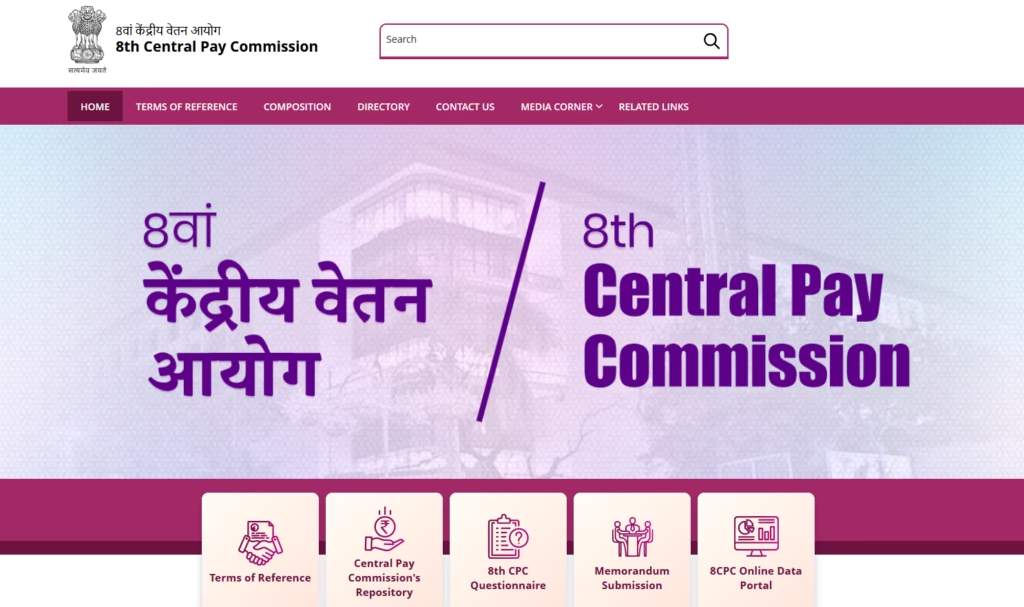
- The Commission has launched an official website and published an 18-question questionnaire to invite stakeholder inputs — ministries, departments, employee unions and pensioners can submit views through the portal.
- The chairperson named to lead the panel is a senior jurist (reported widely in national press), and the body has been given a timeline to submit recommendations.
- There’s early government guidance about the treatment of pensioners and whether any discrimination by retirement date is permitted; Parliament questions have already prompted clarifications.
- While many expect the reference date for pay revision to be 1 January 2026, the final implementation date, fitment multipliers and arrears policy will follow the Commission’s report and the Cabinet’s decision.
Those five bullets capture the most load-bearing facts right now. Below we unpack each item and explain what it means for you.
What is a Pay Commission?
A central pay commission is a temporary expert body set up by the Government of India to review and recommend changes to the pay structure, allowances, pensions and related service conditions of central government employees. Historically, the commissions have roughly followed a ten-year cycle (the 7th Pay Commission’s recommendations were implemented in the latter half of the 2010s), and their recommendations — once accepted by the Cabinet — determine the salary matrices, fitment multipliers and allowance reforms for the next decade.
The commission’s remit typically includes:
- Reviewing the basic pay and proposing a pay matrix and fitment formula.
- Recommending changes in allowances (house rent allowance, transport, special allowances etc.).
- Examining pension rules and recommending pension revisions and rules for arrears.
- Suggesting reforms in service conditions where necessary.
Because the Commission’s decisions affect both current salaries and long-term pension liabilities, the process is also a major fiscal exercise for the government.
How the 8th Pay Commission was constituted and the Terms of Reference (ToR) ?
The formation of the 8th pay Commission was announced in late 2024/early 2025 with the Cabinet taking steps to approve the Terms of Reference that define the panel’s scope and timelines. The ToR usually explain whether the Commission will look at retrospective implementation (i.e., whether revised pay will be effective from a past date), whether defence personnel and centrally-managed pensioners are part of the mandate, and how allowances and special pay will be handled. The government’s official press release detailing the Cabinet’s approval is the definitive record of those ToR and the formal start of the Commission’s work.
What matters practically:
- The ToR set the boundaries of what the Commission can recommend. If an item is outside the ToR, the Commission may not address it unless the Government expands the mandate.
- The ToR commonly specify a deadline for the Commission’s report — often 12–18 months — but interim recommendations or clarifications can be issued earlier on specific matters.
The website launch and public questionnaire
Shortly after formal constitution, the Commission published an official website and released a questionnaire with roughly 18 focused questions seeking inputs from ministries, departments, employees and pensioners. Publishing a questionnaire is a sign that the Commission is collecting data systematically and wants stakeholder views on priority issues: base pay, fitment multiplier approaches, allowances to be merged/retained, transport/health benefits, and the pension revision approach.

Practical takeaways:
- If you are a serving central government employee, an association leader, or a pensioner you can (and should, if you have a viewpoint) submit a response. Agencies and unions will likely coordinate consolidated submissions, but individual submissions carry weight, particularly if they include practical, evidence-backed suggestions.
- The questionnaire answers will feed into data collection and help the Commission model fiscal impacts; thoughtful responses that include numbers (current basic pay levels, examples of hardship created by specific allowances being removed) are more useful than general statements.
- Check the official Commission site for submission deadlines and formats; many news outlets have flagged the window for inputs and the portal address.
Timelines, reference dates and the arrears question
A recurring practical question is: If the Commission recommends higher pay, from what date will the new pay be effective? Recent reporting and official commentary indicate that 1 January 2026 is being treated widely as a reference date for the 8th Commission’s recommendations; however, the exact effective date, arrears entitlement and calculation will depend on the Commission’s final report and the Cabinet’s approval.
Why this matters:
- If the Commission recommends retrospective implementation from 1 January 2026, employees and pensioners may receive arrears for the intervening months, which can be substantial for long-serving employees.
- The size of arrears depends on the fitment multiplier and whether allowances are merged into basic pay — both are technical but high-impact decisions.
- Implementation mechanics (whether arrears are paid in lumpsum immediately, phased, or treated differently for different categories) are political and fiscal decisions made by the government after receiving the Commission report.
Who’s on the panel and key leadership
News reports have identified an eminent jurist as chairperson of the Commission, reflecting the government’s preference for credible, neutral leadership for complex, high-stakes recommendations. The chairperson’s background often signals the panel’s approach: a legal mind may focus on the robustness of rules and pensions law, while economists might push a more macro fiscal modelling approach.
What to watch for:
- The chairperson’s early statements (interviews, public addresses) often clarify whether interim recommendations are a possibility and the broad principles that will guide fitment and allowance reform.
- The composition of the commission (members from finance, defence, labour, pensions experts) determines how balanced the final report is across competing interests.
Pensioners: the big questions and recent clarifications
Pensioners are understandably anxious about potential distinctions based on retirement dates — for example, will those who retired before a cut-off be disadvantaged? Parliamentary questions have already forced the government to clarify that legislative instruments (like the Finance Act 2025) do not allow arbitrary discrimination among pensioners, and that pension revision rules will be framed to avoid unlawful differentiation.
Key points for pensioners:
- Whether a pensioner will receive revised pension depends on (a) the Commission’s recommendations on pension revision, and (b) the Government’s decision on retrospective coverage and effective date.
- If the Commission proposes a uniform revision approach, the Government’s implementing rules will specify cut-off dates and transitional arrangements. Watch official notifications closely.
- Pensioners’ organisations often submit consolidated representations — participating through these channels is usually effective.
Popular expectations vs likely fiscal reality
Unions and employee bodies usually demand a generous fitment multiplier and restoration of allowances that were curtailed in past committees. Some employee groups have even threatened short-term strikes to press for interim relief while the Commission completes its work. News coverage has highlighted these demands and early union activism.
But a Commission’s recommendations are only half the story; implementation requires Cabinet approval and fiscal provisioning. The government must balance:
- The fiscal cost of wage and pension increases (often running into tens of thousands of crores),
- Price stability and fiscal deficit targets, and
- The political imperative of pleasing a large and vocal constituency of government employees and pensioners.
Historically, governments have accepted many core recommendations but have often adapted them (modifying percentages, phasing implementation, or limiting certain allowances) to control fiscal exposure.
What could change: allowances, fitment, matrix and the new normal
While specifics will only be known after the Commission delivers its report, common themes that pay commissions address — and that are likely to appear in stakeholder discussions — include:
- Fitment factor / multiplier — This determines how current pay moves to the new pay matrix. A higher multiplier means larger increases and bigger arrears.
- Pay matrix simplification — Past commissions moved away from complex grade pay systems to matrix formats; the 8th may propose further simplification and clearer progression paths.
- Allowances — Which allowances to retain, rationalise, or subsume into basic pay is always contentious; some calls come from departments wanting to retain special allowances for skill premiums, while the finance side argues for consolidation.
- Pension revision & indexation — The Commission will likely revisit pension linkages, family pension slabs and whether certain pensions need additional protection.
- Special categories — Defence pay (and allowances for field/operational service), paramilitary, doctors/teachers in government hospitals and educational institutions often have separate considerations that the Commission may address.
Expect debate and lobbying on each point.
What you (employee or pensioner) can do now — a short action plan
- Understand the questionnaire and respond — If you have a practical, specific point (for example: “merging X allowance into basic will cause unintended tax consequences for mid-level grades”), submit a short evidence-based response on the Commission portal. Consolidated, data-rich replies are persuasive.
- Engage through your union or staff association — Associations often coordinate technical memos that the Commission reads; contributing to that memo amplifies your voice.
- Track official announcements — Use the Commission’s website and PIB/Finance Ministry releases for authoritative updates, not social media rumours.
- Prepare financially for arrears timing uncertainty — Many households count on arrears; prudent budgeting assumes possible delays between recommendation and actual payment.
- For pensioners: ensure documentation is ready — When rules for revised pensions are notified, claims and documentation may be required to process arrears and changed pension amounts. Keep pension slips and identity documents current.
Looking ahead: what success looks like
A successful 8th Pay Commission outcome is one that:
- Produces a fair and transparent pay matrix which recognises skills and experience;
- Rationalises allowances to reduce needless complexity while protecting essential compensatory allowances;
- Provides pension security by setting clear, non-discriminatory rules; and
- Balances fiscal responsibility with the legitimate aspirations of employees and pensioners.
For employees and pensioners, success also means a predictable implementation process and clear communication on arrears, tax treatment and payroll mechanics.
Conclusions — keep engaged, stay informed
The 8th Central Pay Commission’s early steps — official constitution, ToR approval, website launch and stakeholder questionnaire — show the government intends a consultative and data-driven process. That said, the journey from recommendation to implementation runs through cabinet approval and fiscal choices. Your best strategy as an employee or pensioner is to stay informed through official channels, participate constructively in consultations (individuals and unions), and prepare for the practical timeline realities of implementation.
A note on sources and staying updated
This article is based on the Commission’s formal announcements (Cabinet/PIB), the live Commission website and reporting from major national outlets summarising the Commission’s launch, chairperson and initial steps. Key official sources and reputable national publications are your best way to track status and deadlines.
Frequently Asked Questions (FAQs)
The Commission will recommend a new pay structure and fitment formula; the Cabinet decides on implementation. Recommendations may be universal (applied to all) but the scale of increase will vary by grade and category.
That depends on the government’s implementation plan. Historically, arrears are paid after Cabinet approval and the Finance Ministry’s notification; timelines can vary from months to over a year.
Merging allowances into basic is always discussed. The Commission will weigh fairness, fiscal cost and operational needs; some allowances may get rationalised, others retained.
Central Pay Commissions apply to central government employees. Some state governments sometimes take cues and revise state pay rules, but they act independently.